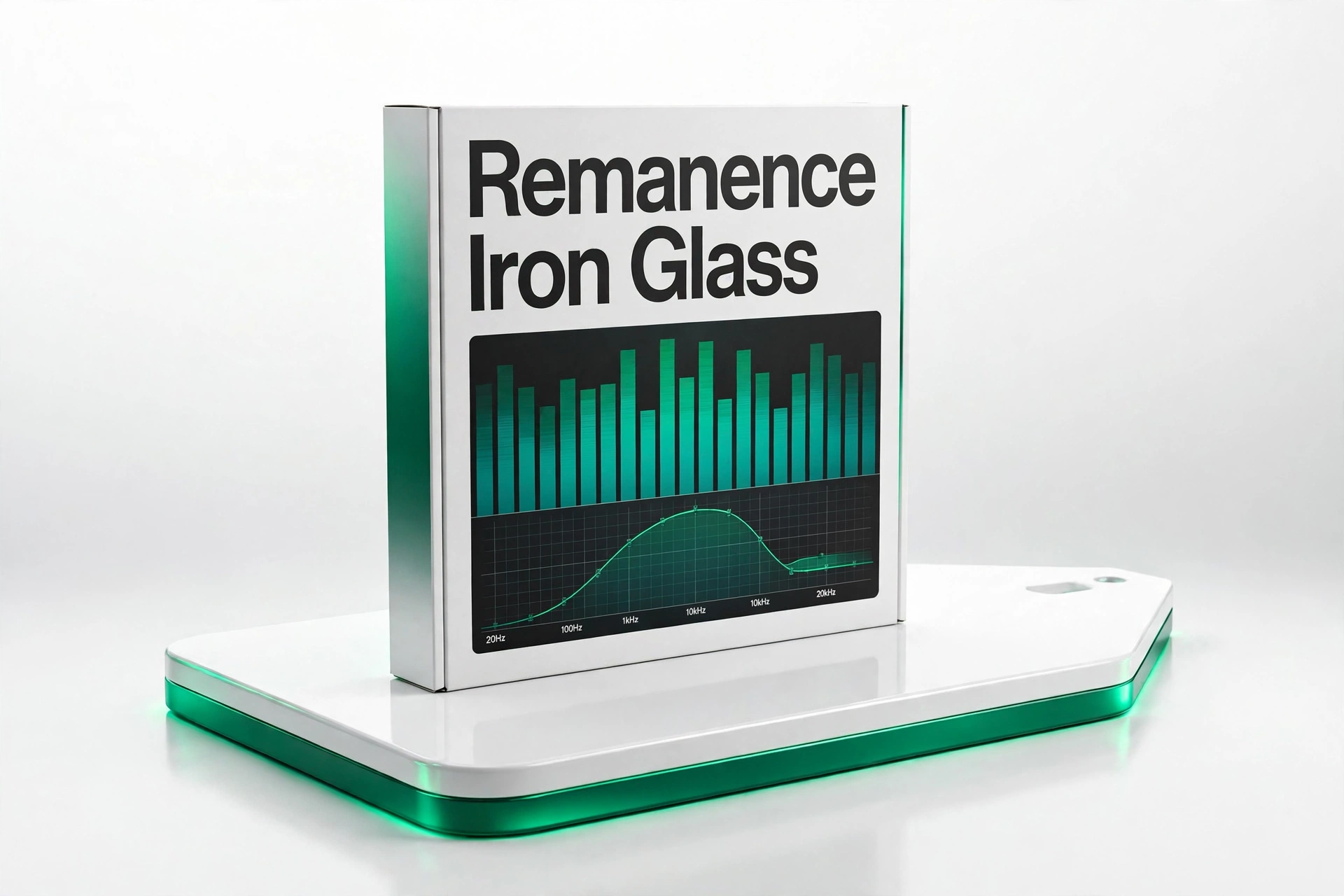
Plenty of plugins promise analog warmth and deliver a saturation knob glued onto a digital EQ. Iron Glass refuses that shortcut. Remanence Audio modelled the actual circuitry — tube stages, transformers and an inductor network — and then built five parallel EQ bands through it, so the tone shaping and the analog character are the same process rather than two effects arguing in series. On the board at $39.99 against an $81.82 list price, it is circuit-level mastering colour at utility money, and it earns a closer look than most EQs at twice the price.
A Circuit First, An EQ Second
The architecture is what separates this from the crowd. In a conventional serial EQ, each band hands its output to the next and the errors compound politely. Iron Glass runs its five bands in parallel against the same signal and blends them back together, the way classic passive designs behave. Push one band and the whole circuit answers: the remaining bands, the tubes and the transformers all react to the new balance. Broad moves stay musical, small moves stay coherent, and the result feels less like applying gain at frequencies and more like persuading a piece of hardware to lean in a direction.
That persuasion extends to the hardware behaviour itself. The controls for the tube and transformer stages are not ordinary drive knobs; they change the characteristics of those modelled stages, so you are adjusting how the circuit is built, not just how hard you hit it. The very name of the company points at the idea: remanence is the memory magnetic material keeps after saturation, the way transformer iron does not snap straight back to neutral after a transient passes. That lingering response is a large part of why hardware feels deep, and it sits at the centre of this design.
Filters And Gain That Belong To The Circuit
The high-pass and low-pass filters follow the same philosophy. Rather than bolting on generic digital filters, they are modelled after real inductor-based circuitry, so tidying sub-bass or taming top-end energy contributes character instead of sitting outside it. Input and output gain controls, each with a range of ±18 dB, govern how hard the circuitry is driven and let you level-match afterwards — the practical combination you need when experimenting with the relationship between EQ moves and circuit response on a master.
In use, the natural home is mastering, where gentle low-end adjustments, subtle presence changes and high-frequency shaping can happen in one pass while the modelled stages add cohesion. It behaves just as well on a mix bus, where a small amount of EQ plus controlled drive gives a mix density, and on individual tracks — vocals, drums, bass, guitars, synths, piano, strings — where the colour can be pushed harder for identity. As with hardware, restraint pays: small changes produce outsized perceived differences.
How It Started, And What You Get
Iron Glass began as a free JSFX experiment that approximated analog behaviour with interconnected DSP layers. The full plugin is the grown-up rebuild: proper circuit modelling aimed at engineers who want EQ and coloration in a single processor. It runs as VST3, AU and AAX on supported macOS and Windows systems — macOS 11 and later on Intel and Apple Silicon, 64-bit Windows 10 and later — with fully offline licensing and a fully functional 14-day trial if you want to audition it on your own masters first.
The Deal
Do the maths: $81.82 down to $39.99 is 51% off a mastering EQ whose entire design is a circuit, not a curve. If your masters measure correctly but feel cold, this is the $40 experiment most likely to fix the feeling. Board verdict: analog behaviour, mastering manners, half-price ticket — an easy add to the chain.






 Download instantly from Plugboutique
 Instant Digital Delivery
 Free 2-Day returns if not work














Reviews
Clear filtersThere are no reviews yet.